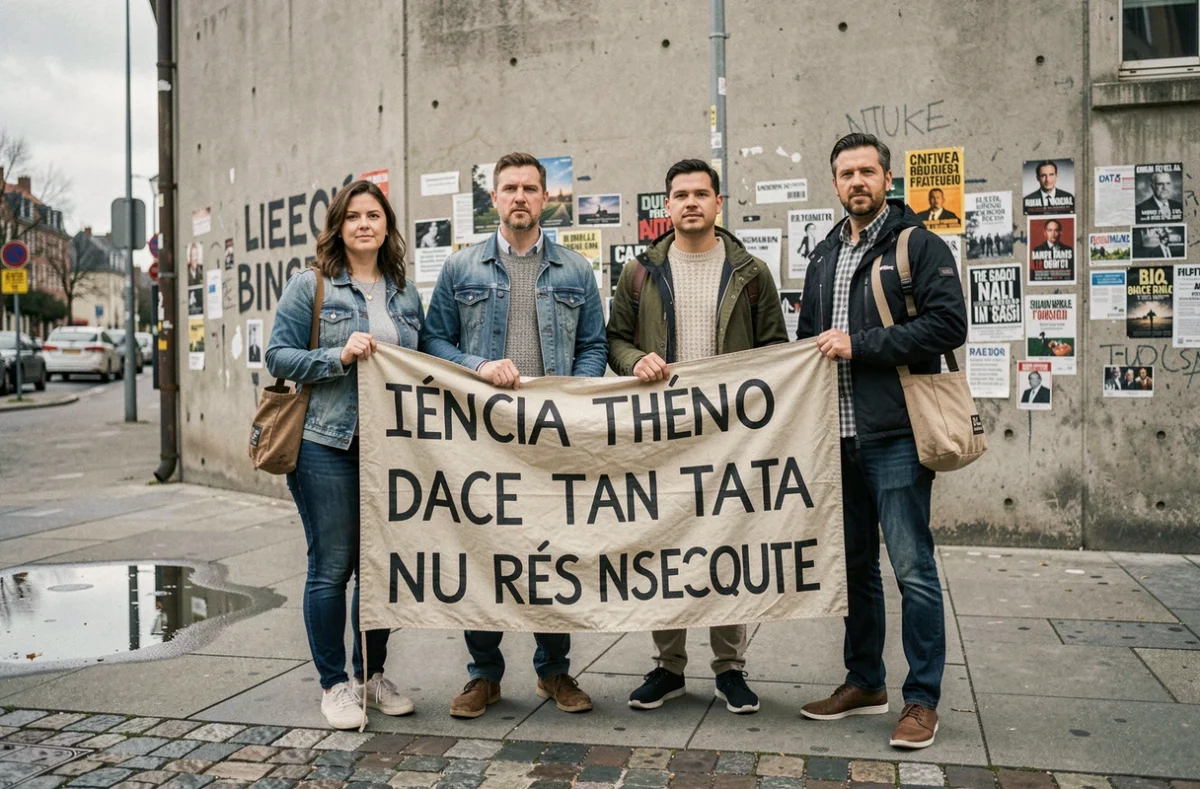
The slogan “Siamo tutti antifascisti” has been circulating in European marches for decades, but its recent linguistic variations raise a specific question: what do we change in the political message when we modify the gender marker in the phrase? Between the generic masculine Italian “tutti,” the feminine “tutte,” the inclusive form “tuttx,” and the French translations, each variant encodes a distinct positioning.
Variants of the antifascist slogan: comparative table of documented forms
The different variations of “Siamo tutti antifascisti” are not merely a typographical game. Each corresponds to a specific militant context and an identifiable political intention.
| Form | Language | Grammatical Gender | Documented Context |
|---|---|---|---|
| Siamo tutti antifascisti | Italian | Generic masculine | Historical slogan, used during the Dro rally against “Ritorno a Camelot” (August 2026) |
| Siamo tutte antifasciste | Italian | Feminine plural | Venice march, September 19, 2026, carried by feminist collectives |
| Siamo tuttx antifascistx | Inclusive Italian | Neutralization by “x” | Used by queer collectives, documented by the journal La Déferlante |
| Nous sommes tous antifascistes | French | Generic masculine | Common translation in protests in France |
| Nous sommes tou·tes antifascistes | Inclusive French | Midpoint | Francophone militant variant, inclusive writing |
What stands out in this table is that each variant marks a break with the original slogan along a specific axis: gender, language, or mode of address. The historical form in Italian, in the generic masculine, remains the most widely used in international marches.
Several news articles published on Perspective Media detail these linguistic evolutions and the contexts in which they appear.

Feminine, inclusive, generic masculine: what the gap between forms reveals
The form “Siamo tutte antifasciste,” chanted in Venice in September 2026, does not merely include women. It claims a political enunciation in the feminine, carried by feminist collectives that refuse the subsumption of the feminine under the generic masculine.
The form “tuttx/antifascistx” operates differently. The replacement of gendered endings with the letter “x” aims to neutralize grammatical binarity itself. The journal La Déferlante documented this variant within a queer antifascist front, where the issue is not to feminize the slogan but to eliminate any gender assignment in the collective address.
What French adds to the debate
The shift to the French language introduces an additional constraint. French has the midpoint (tou·tes) as its main tool for written inclusivity, but this tool remains contested in the public and media space. The translation “Nous sommes tous antifascistes” dominates in Francophone marches, including those that otherwise display feminist demands.
This asymmetry between Italian and French is notable:
- Italian allows substitution by “x” without altering the chanted pronunciation of the slogan, facilitating its oral use in protests
- French, with the midpoint, creates a form that is primarily written, difficult to chant collectively in a march
- The preservation of the original Italian (“Siamo tutti antifascisti”) in Francophone contexts functions as a marker of transnational belonging, regardless of grammatical gender
The choice of language and grammatical form is therefore not a stylistic detail. It encodes a power dynamic between antifascist universalism and identity politics.
Constitutional antifascism in Italy: a slogan turned program
The slogan now transcends the context of marches to enter an institutional logic. The movement “Tutti per una, l’Italia antifascista per tutti,” created in 2026, organizes public readings of the Italian Constitution, including in minority languages and dialects. The stated goal is to defend the XII transitional and final provision, which prohibits the reconstitution of the fascist party.
This initiative, documented by Il Cittadino Online in September 2026, shifts the terrain of antifascism from street slogans to constitutional pedagogy. The word “tutti” regains its literal meaning: all citizens, without distinction, are concerned by this legal provision.
Recent mobilizations against neo-Nazi gatherings
The slogan was reiterated during the antifascist rally in Dro, in Trentino, organized against the far-right event “Ritorno a Camelot.” According to a report from Proletari Comunisti dated August 30, 2026, the slogan functioned there as a unifying rallying cry against an explicitly neo-Nazi gathering.
The coexistence of both classic masculine and feminine forms in the same march shows that the variants do not replace each other: they coexist and signal distinct positions within the same mobilization.
Antifascist slogan in French: translation or political transformation
Translating “Siamo tutti antifascisti” into French does not simply mean transposing a message. The choice between “tous,” “tou·tes,” or maintaining the Italian itself constitutes a political act in itself.
The Italian formula carries a historical weight that the French translation does not bear: it directly refers to the Italian resistance of the 1920s-1940s. The retention of Italian in French marches functions as a citation, asserting a lineage with Italian antifascism rather than with the French political tradition of the Popular Front or the Resistance.
- The original Italian version anchors the slogan in a precise historical memory related to Mussolini’s fascism
- The French translation “Nous sommes tous antifascistes” universalizes the statement but loses this lineage
- The inclusive forms (“tuttx,” “tou·tes”) add a dimension of gender politics absent from the original slogan
The multiplicity of variants does not dilute the antifascist message. It maps the internal fractures within the movements that carry it: between universalism and identity politics, between historical memory and contemporary demands, between the chanted oral and the militant written. Each form of the slogan is a positioning, and it is precisely this diversity that makes it an object of political analysis, not just linguistic.