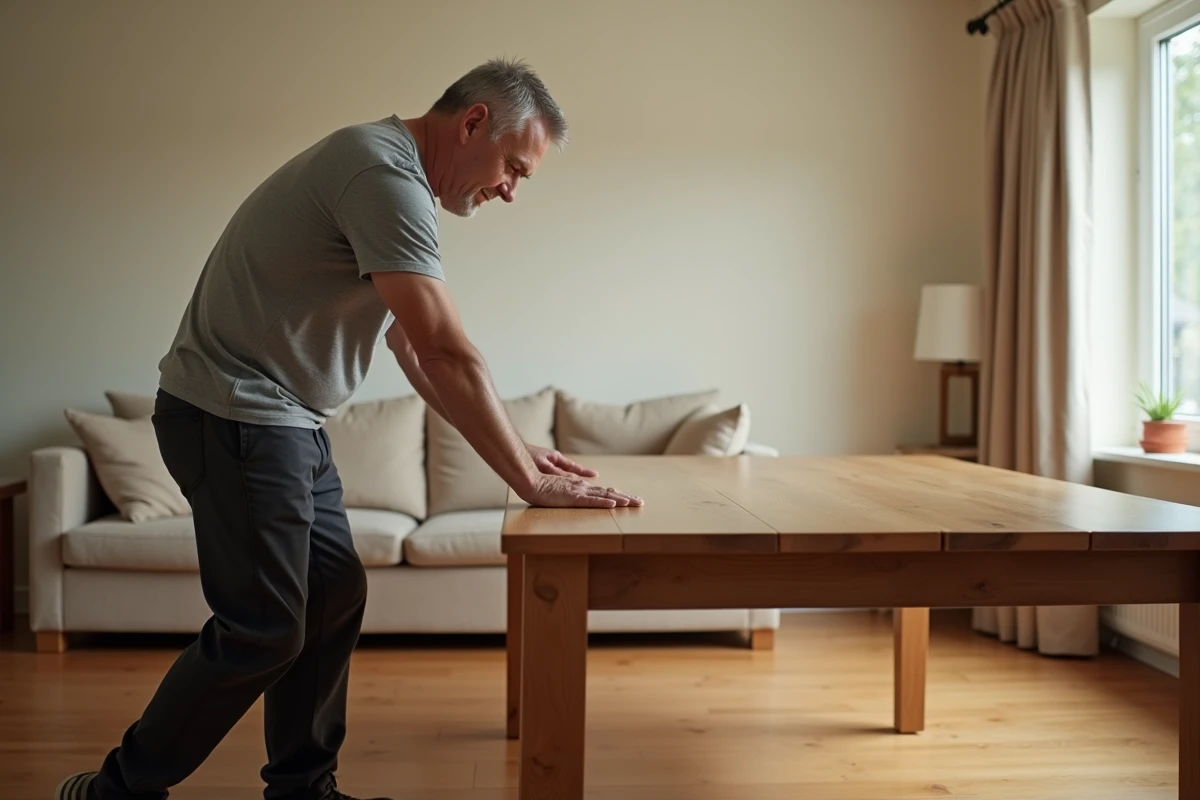
A solid oak table set upside down in the living room, legs in the air, and no one around to help. This situation occurs more often than we think, especially after a solo assembly or a delivery dropped flat. Turning a heavy table without injuring oneself requires less brute strength than one might imagine, provided the right method is chosen and the action is prepared.
Side tilting with wedges: the safest method for turning a heavy table
Turning a table is not the same as moving it: we change its orientation, not its position in the room. The reflex to lift the entire table to pivot it with outstretched arms is the riskiest for the back.
Side tilting with stable wedges yields much better results in terms of safety. According to the ANACT practical guide on gestures and postures in amateur DIY (2026 edition), side tilting with wedges surpasses direct lifting for solid wood tables.
One can easily turn a heavy table by proceeding in gradual steps rather than in one single movement. The principle: bring the table onto a long edge, stabilize it with improvised wedges, then guide the rotation down to the floor.
We start by sliding the table towards a wall or a corner of the room that will serve as a stop. Then we tilt the table onto its long side by pushing from the opposite edge, never pulling. Once on its edge, we place wedges (thick books, logs, bricks) to block the position. Then we guide the controlled descent to the final position, legs down.
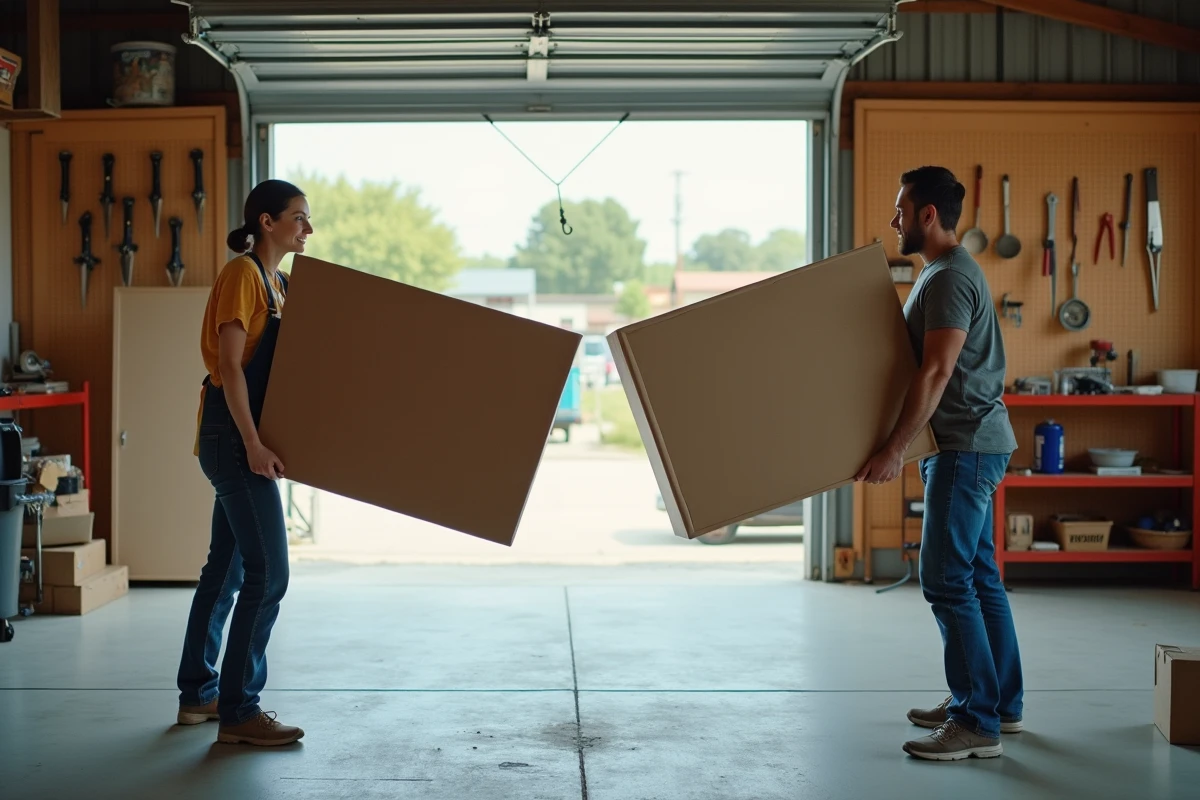
Turning a table alone when you are senior or have reduced mobility
Strength is not the limiting factor. What poses a problem is the speed of the action and the instability during the rotation. For an elderly person or someone with joint pain, the key is to break down each phase into locked micro-steps.
Low-tech tools already available at home
No need to buy specialized equipment. Most households have everything needed to secure the turning:
- An old blanket folded in four, slipped under the tilting edge, protects the floor and cushions jolts during the rotation
- Couch cushions stacked against the wall serve as a soft stop and absorb the shock if the table tilts too quickly
- A broom handle wedged under the tabletop serves as a lever to initiate the tilt without straining the shoulders
- Rolled bath towels wedged under the feet prevent lateral slipping during the maneuver
Adapting the rhythm and posture
We work from a semi-squatting position, never leaning forward with a rounded back. The knees remain bent, arms close to the body. If the table is too wide to be controlled at arm’s length, do not attempt the action alone.
For individuals with lower back issues, pivoting lifting straps significantly reduce the load on the lower back. Feedback from moving professionals confirms their effectiveness, even on uneven surfaces like outdoor patios.
Feedback varies on this point, but a stable stool placed at mid-height can serve as an intermediate step: we tilt the table onto the stool, take a breath, then finish the rotation. Two short movements tire less than one long movement.
Protecting the floor and the table during the turn
The top of a solid wood table falling a few centimeters onto tile can result in a chipped edge or a cracked tile. Protecting the floor and the furniture should be prepared before touching the table.
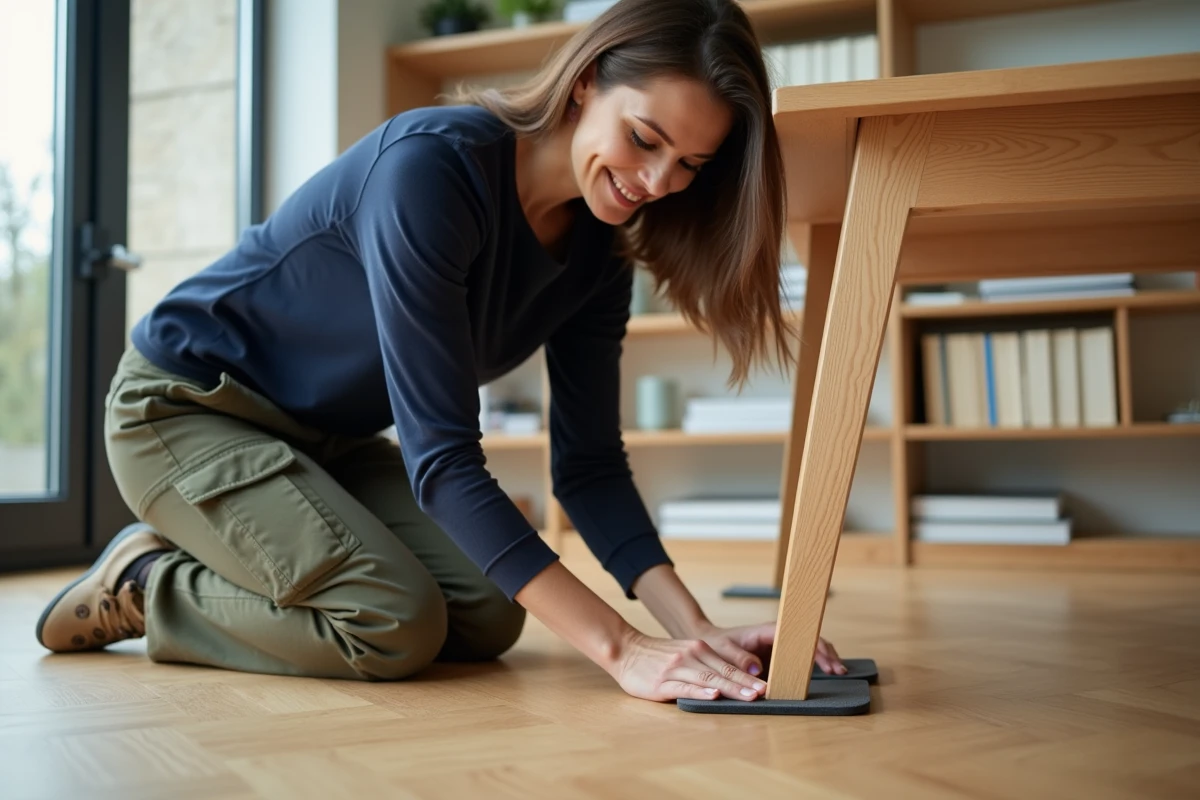
Lay a thick blanket over the entire receiving area before starting. Also cover the edge on which the table will pivot with a thick cloth or a piece of carpet. If the floor is slippery (tile, varnished parquet), a non-slip mat or even a simple folded sheet under the contact area prevents the table from slipping during the tilt.
For fragile tops (tempered glass with edging, marble), protect the upper surface with corrugated cardboard secured with tape. The turning generates vibrations: a marble top placed unprotected on a metal edge can crack from transmitted shock.
Common mistakes that cause back injuries
Acute low back pain is the main risk. It is almost always triggered by the same pattern: trunk rotation under load, arms extended, feet fixed on the ground.
Three mistakes consistently occur when turning a heavy piece of furniture without preparation:
- Pulling the table towards oneself instead of pushing it, which places all the load on the lower back and removes the support from the legs
- Holding one’s breath during the effort, which increases abdominal pressure and destabilizes the action
- Working in socks or barefoot on a smooth floor, which causes loss of grip at the moment the table tilts
Push rather than pull, exhale during the effort, wear closed shoes: these three reflexes reduce most risks. One should never lift the table above waist height. If the tabletop exceeds belly button height during the rotation, it means the chosen method is not correct.
When the table weighs more than can be controlled with side tilting, it is better to disassemble the legs, turn the top alone, then reattach. A screwdriver and ten minutes of disassembly are worth more than a week off for a lumbago.