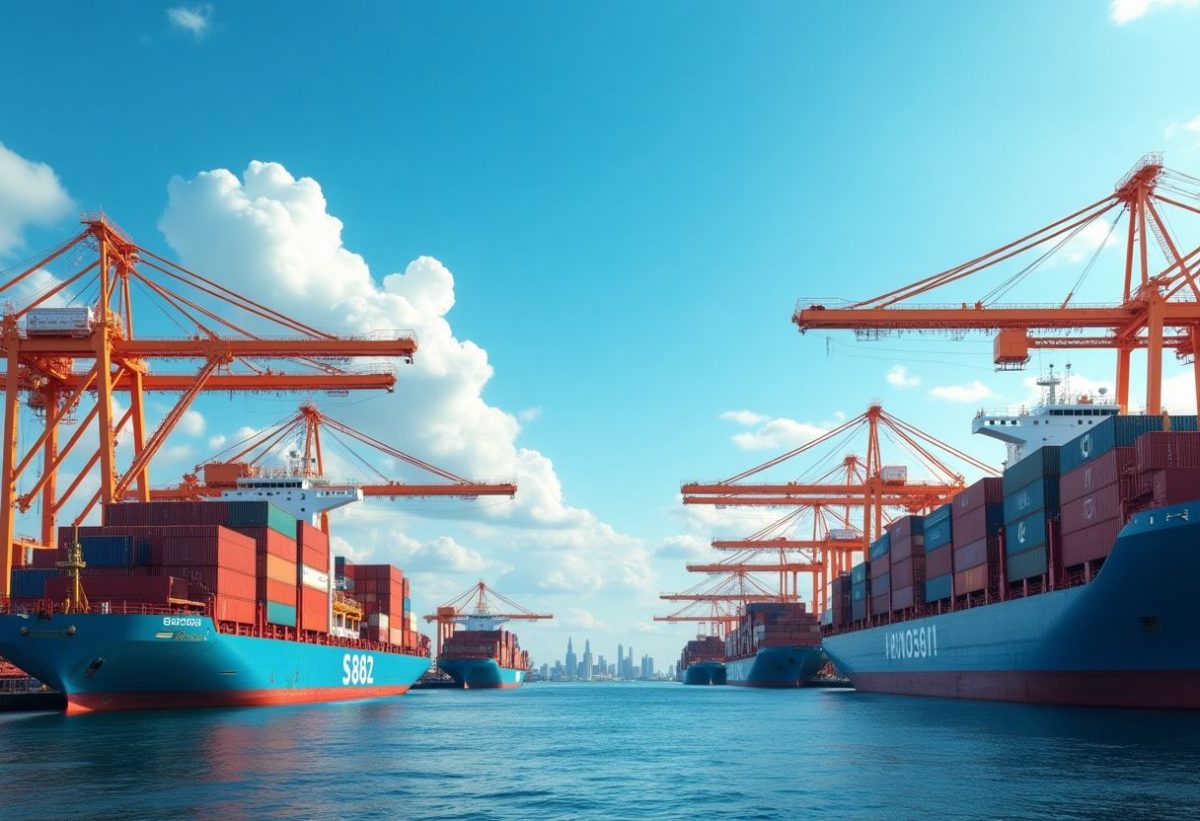
In an interconnected world where borders blur and distances shrink, international transport plays a fundamental role in the global economy, facilitating exchanges between nations and contributing to their growth. Global logistics resembles a gigantic web, connecting continents through a myriad of maritime, air, rail, and road networks. These different modes of transport meet various needs, ranging from delivery speed to cost reduction, while adhering to increasingly strict environmental standards.
Transport modes: diversity and specifics
Each mode of transport presents unique characteristics, suited to specific types of goods and distances. The diversity of these logistical solutions offers companies the necessary flexibility to optimize their supply chains.
- Maritime transport: The main vector of global trade, it ensures the transport of the majority of goods due to its ability to move massive volumes at lower costs. Container ships traverse the oceans, linking global ports by forming strategic trade routes.
- Air transport: Although more expensive, it offers unmatched speed, essential for transporting perishable or high-value goods. Cargo planes serve direct routes, minimizing delivery times and ensuring increased reliability.
- Rail transport: Combining efficiency and sustainability, rail networks are ideal for transporting heavy goods over long distances, particularly on the Eurasian and North American continents.
- Road transport: Complementary to other modes, it is essential for transporting goods over short distances, allowing for fine and precise distribution to points of sale or consumption.
Environmental impact and sustainable innovations
International transport finds itself at a crossroads where the need to reduce its environmental impact becomes urgent. Technological innovations and green policies are emerging as essential responses to the ecological challenges facing the sector.
Companies are developing new technologies to increase the energy efficiency of vehicles. Hybrid-powered ships and fuel-efficient planes represent notable advancements.
At the same time, route optimization through artificial intelligence helps reduce carbon emissions. Initiatives such as funding ecological projects or adopting renewable energy sources are encouraged by increasingly strict international regulations.
Thus, the international transport sector is actively engaging in an ecological transition, combining operational efficiency with environmental responsibility.
Regulations and standards: an essential framework
International transport is governed by a complex set of regulations and standards that ensure the safety, reliability, and fairness of global exchanges.
- Trade agreements: They establish tariff and non-tariff rules, facilitating exchanges by reducing customs barriers.
- Safety standards: International organizations impose strict standards to ensure the safety of goods and people. This includes securing infrastructure and training personnel.
- Environmental standards: They aim to limit the transport impact on the ecosystem by imposing restrictions on polluting emissions and promoting cleaner technologies.
Economic and geopolitical challenges
International transport evolves in a constantly changing economic and geopolitical context, influenced by factors such as trade tensions, economic fluctuations, and health crises.
Companies must navigate through these uncertainties. Diversifying supply chains becomes a key strategy to mitigate risks. Geopolitical tensions can also influence trade routes, leading to strategic readjustments. Health crises, such as the COVID-19 pandemic, have highlighted the fragility of logistical chains.
Companies have had to innovate rapidly to adapt to new realities, such as the increase in e-commerce and changes in global consumption habits.