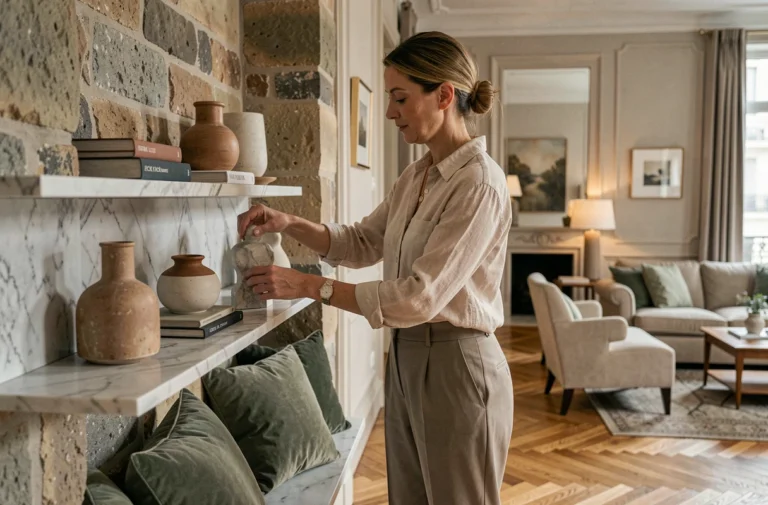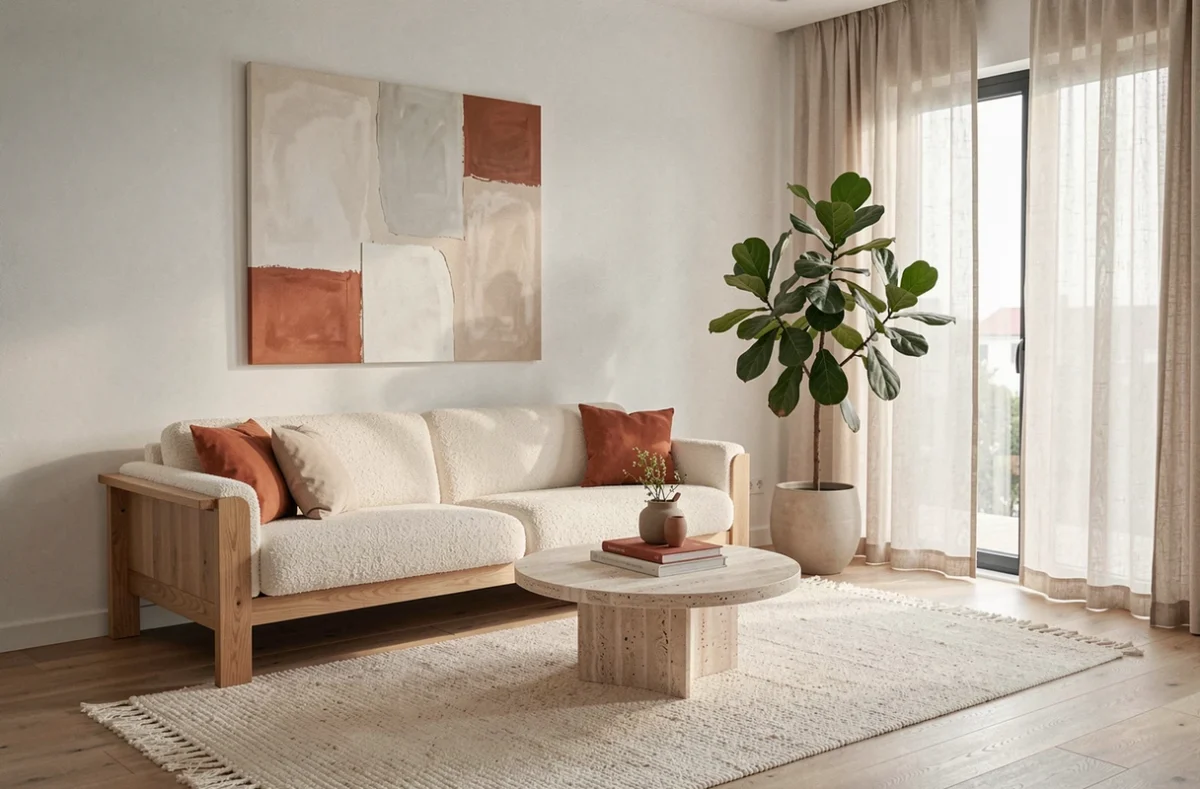
A corduroy sofa that pulls away from the wall to free up a passage, raw linen cushions placed on a walnut bench, a brushed brass light fixture hanging deliberately low: design decoration is built from precise gestures, not copied Pinterest lists. Transforming an interior often starts with a concrete irritant (a room too dark, a living room without identity, aging furniture) and the solution rarely comes down to a single purchase.
Removable and repairable furniture: the true criterion for choice in design decoration
You buy a designer coffee table, scratch it within three months, and discover that you need to replace the entire top because nothing is removable. This scenario is gradually becoming less common.
The 2025 panorama from ADEME, relayed by the National Institute of Circular Economy in September 2026, confirms that eco-contributions now integrate sustainability, reparability, and the incorporation of recycled materials. The bonuses and penalties applied to manufacturers steer the supply towards pieces designed to last.
In practical terms, when choosing a designer piece for your interior, checking that it is removable and repairable becomes as relevant a reflex as checking its dimensions. A screwed base rather than a glued one, a replaceable covering, available spare parts: these details separate a sustainable purchase from a disposable decor.
Reuse is no longer confined to flea markets. It is becoming a fully-fledged design angle, and several contemporary furniture brands now offer ranges designed from the outset for disassembly and second life. When you take the time to explore decor on 100,000 Watts, you quickly spot pieces that adhere to this logic without sacrificing aesthetics.
Trendy colors for autumn 2026: warm palette and material contrasts
The shades that are emerging this season do not fall from the sky. They respond to a need identified by influencers: warming up interiors dominated by white and gray for a decade.
Eggplant, tobacco brown, and lime
According to trends reported by several decor media, the fall 2026 palette revolves around eggplant, tobacco brown, and lime tones. These colors work through material contrasts: a matte lime-coated wall against a brown leather armchair creates a dialogue of textures that monochrome does not allow.
For a living room, one can limit oneself to two saturated shades and keep the rest neutral. A common mistake is to multiply strong colors on every wall, which crushes the volumes instead of revealing them.
Airbnb and colors that rent well
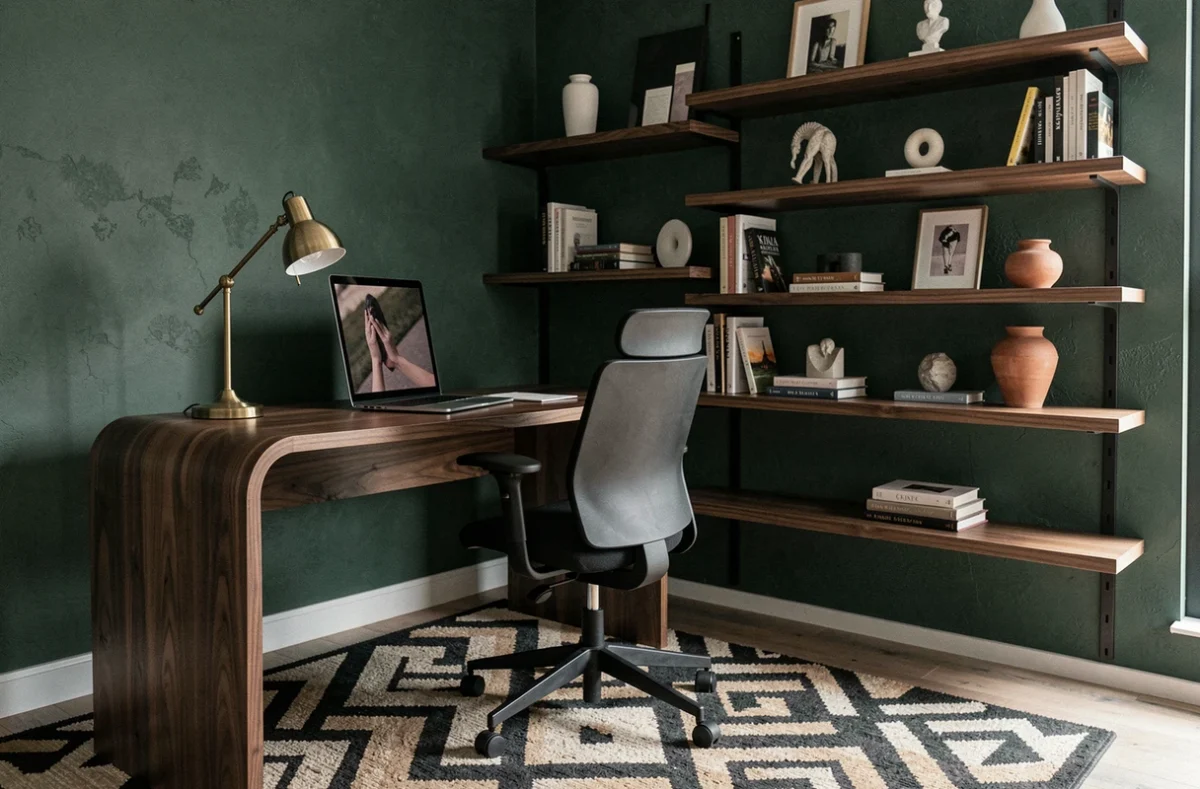
Marie Claire Maison has reported on the trendy colors identified by Airbnb for autumn 2026. If you are decorating a property intended for seasonal rental, opting for deep tones (burgundy, terracotta, forest green) offers a double advantage, aesthetic and commercial.
Biophilic decoration: beyond green plants placed on a shelf
It is often thought that biophilic decoration is limited to aligning monstera pots on a TV unit. Research on this subject is progressing significantly, and the approach goes much further.
Biophilic decoration structures the space around natural light and living materials. Leaf-patterned wallpaper (a marked trend in 2026 according to La Voix du Nord), unvarnished raw wood, natural stone as a backsplash, transparency games with glass partitions: the goal is to recreate a sensory connection with the outside.
- Favor materials with visible textures (wood grain, stone veining, linen weave) rather than smooth, uniform surfaces.
- Orient seating towards sources of natural light, even if it means breaking the classic symmetry of the living room.
- Incorporate plant elements at height (hanging plants, high shelves) to free up floor space and add verticality.
Feedback varies on this point: in poorly lit rooms, an excess of dark wood and dense vegetation can weigh down the atmosphere instead of lightening it. It is beneficial to test with a single wall before generalizing.
Organic lines and contemporary style: adapting curved shapes to a small space
Sofas with curved armrests, tables with softened edges, asymmetrical mirrors: organic lines replace systematic right angles.
In a large living room, this works immediately. In a modestly sized apartment, it is less obvious. A rounded sofa requires more space than a straight model, and an XXL organic mirror will visually consume a narrow wall.
The operational solution is to reserve curves for small pieces of furniture (side tables, light fixtures, occasional seating) and to keep straight lines for structural furniture (bookshelves, buffets, main sofas). This balance creates movement without sacrificing square meters.
Chrome and brass: two finishes, two atmospheres
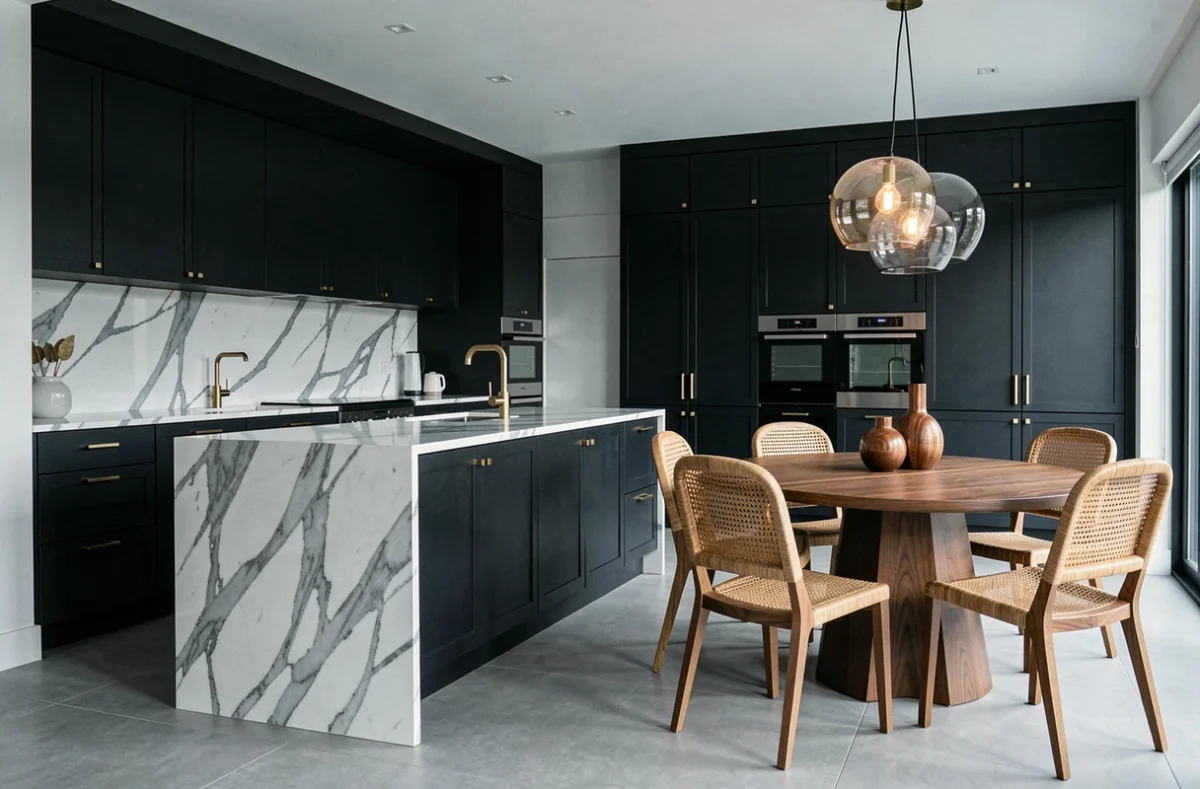
The return of chrome in bases and handles brings a touch of contemporary shine. Paired with deep velvet or dark wood like walnut, chrome creates a sharp contrast between matte surfaces and reflections. Brushed brass, on the other hand, warms things up more and pairs better with terracotta or eggplant palettes. Mixing the two in the same room works if one of the two is limited to a single focal point.
- Chrome: ideal with cool colors (pearl gray, midnight blue, off-white) and a clean design style.
- Brushed brass: more suitable for warm interiors, autumn palettes, natural textures.
- Avoid dispersing the two finishes across main furniture, reserving one for accessories (handles, frames, candlesticks).
This approach of “layering,” meaning the layering of materials and finishes rather than uniformity, is gaining ground in contemporary design. The idea is not to match everything but to create visual layers that add depth to each piece.
Transforming an interior with design decoration relies on concrete choices: repairable furniture rather than disposable, two deep colors instead of five, curves measured according to available space. The most effective approach remains to start with a single piece, a single decision, and to live with it before going further.